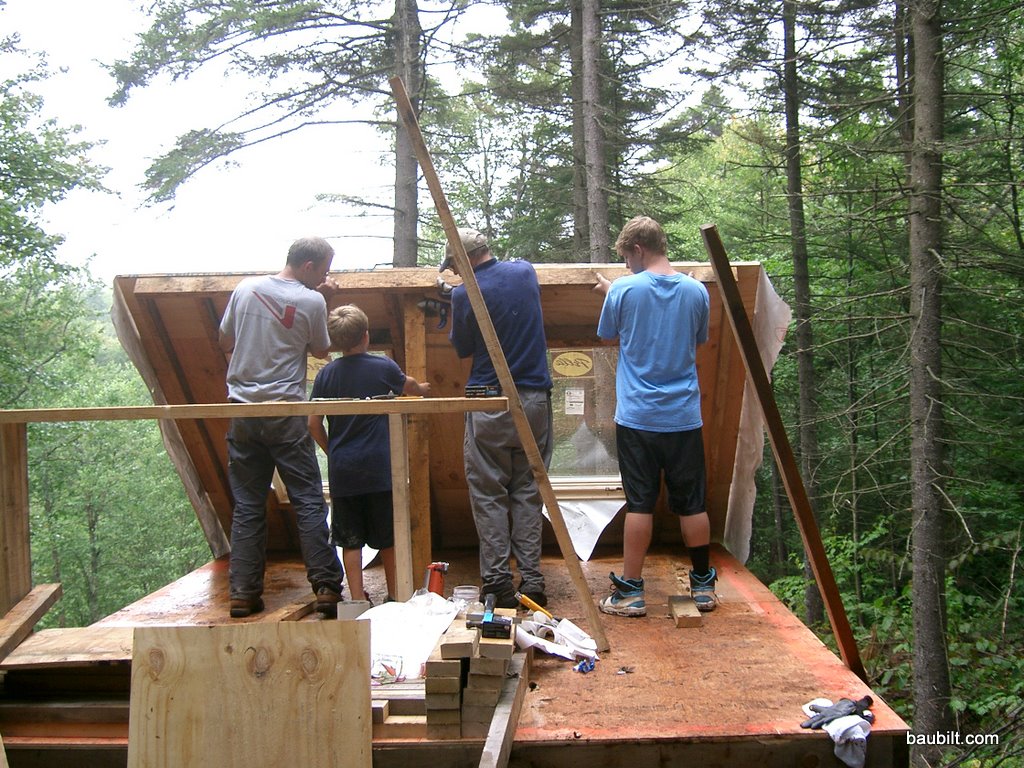
The framing of the cabin was straightforward. We used rough-sawn lumber and 3/4 inch plywood sheathing. I used a simple framing scheme with no headers above the windows and a single top plate on the walls. I used 3/4 inch plywood power nailed to the lumber with ring-shank nails to tie everything together into a strong and stiff wall system. I was confident that with this heavy sheathing, the minimal structure would be plenty strong.
Dimensional lumber used in framing (i.e., 2×4, 2×6, etc.) is usually sold after planing and kiln drying. That’s why a 2×4 is actually 1.5″ x 3.5″. The stick of lumber from which that 2×4 was made was originally sawn to dimensions of 2″ x 4″. The length of these “rough sawn” boards is the nominal length plus at least 2 inches. So an 8′ 2×4 in rough-sawn form is 2″ x 4″ x 98+”.
You can buy rough-sawn lumber at most saw mills. Most of the time what you buy is “air dry” from stacks that have sat out in the mill’s yard for a year or so. The moisture content is still high, say 20%, but nothing like true green lumber right off the saw.
Windows (12 Pella ProLine casements w/screens) $3623
Stove (Morso Squirrel) $1100
Chimney and stove pipe (Simpson) $500
Flooring (Forbo Marmoleum Click) $502
Cost before adjustments $9458
Adjustments:
Forgone BMW purchase ($44,260) …’cuz that’s what my friends are buying instead of doing stuff like this.
12 days labor of high-priced innovation consultant (not thinking about that)
Net Savings $34,802
Incidentally, I purchased the site for $8500, plus another $1000 or so in legal fees and transfer fees/taxes. (One of a half dozen lots I was able to aggregate in a largely defunct development.) So, even including the land costs, this project was well under half the cost of the BMW, and I believe it will be around a lot longer than that car would have been.
Incidentally, Dunn Lumber has an excellent site with prices listed for most lumber-yard items. This is a great reference for cost estimating, even though you most likely will not purchase from them unless you live in their service area.
Our church house was constructed with a rubble-stone foundation. That means basically that the builder dug a deep hole in the ground and then started constructing thick stone walls to form the perimeter of the structure. The walls are about 24 inches thick at the base. They seem to extend 2-4′ below the level of the lower-level floor, which is between 10′ and 6′ below grade depending on where one is on the slope of the site.
As the walls extend upward they become thinner. At the top of the building they are about 12-14″ thick. When the walls emerge from the grade, the outer face is nicely dressed and pointed, whereas the inside face remains pretty rough.
The main level of the church was supported by a single beam running the long way down the middle of the sanctuary with three cast-iron columns further supporting the beam and resting on a rubble-stone footing. There was just one stone column supporting a section of the wall under which the side entrance was located. We wanted to remove that column, and so installed a steel beam to support the wall, as shown in the photo.
While we liked the location, the basic architectural form, and the overall size of the church house, it had several major deficiencies:
We had two tiny bedrooms on the upper level with 7′ ceilings and we had two rapidly growing boys. We envisioned six-foot teenagers and their friends cramped in that space.
We had no family/tv room.
We could not get to our backyard, except through a convoluted path down an improvised stair.
There was no off-street parking, nor bulk storage area (e.g., Shed, garage, etc.).
We had 1500 square-feet of lower level (former apartment) but couldn’t really get to it and it was not comfortable even if we could get to it.
We had an improvised master bedroom spanning two smaller bedrooms, which was kind of in the middle of the main living area.
So, the charge we gave to the architects was: connect the lower level and main level so we can use them both, give us access to our yard, and provide a TV room, master bedroom, and living space for the boys. We also asked them to think about solving our parking problem, but I was not optimistic about that one.
One of my goals for this project was to tread lightly on the land.
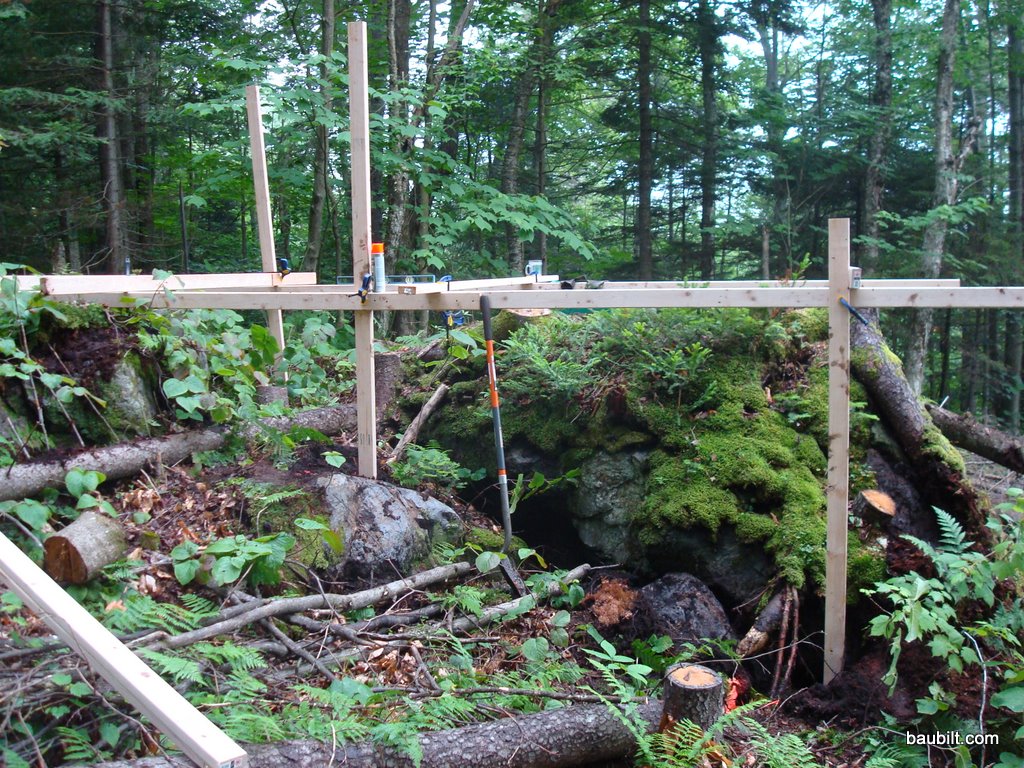
The high spot of the site was a boulder maybe 16 ft. x 8 ft. and protruding 8 ft. above grade at one end. I decided that a nice approach would be to set the structure on the boulder. I reasoned that the boulder probably extended several feet below ground and was probably not going to move much over my lifetime.
Here I laid out the structure with some 2x4s to figure out how to orient it relative to the boulder. The boulder is covered with moss and lots of wet organic stuff as is typical of this part of Vermont.
I used an angle grinder (I’m quite happy with this Bosch model) and a diamond blade to cut some flat spots in the boulder for the six points where I planned to support the structure. (So much for treading lightly some of you might observe…but these little cuts are nothing like blasting a big hole in the ground and pouring a foundation.)
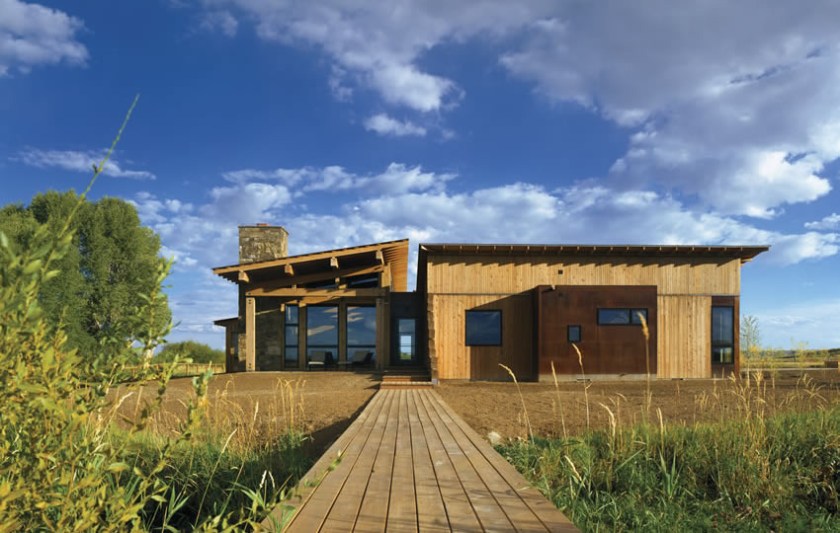
In my first meeting with architects Eric and Andy (Carney Logan Burke Architects), they asked about my stylistic preferences, invoking the idea of a stylometer for gauging client style. Since I had picked them in part because I liked the houses they had designed for themselves, I was pretty confident the stylometer would give similar readings for us. Here is what I can articulate about my own stylistic preferences, to which I’ll add a few points which Eric and Andy brought to the table and to which I’ve come to subscribe.
My style elements (which were shared entirely by Eric and Andy):
I searched far and wide for architects who both shared my aesthetic values and who did interesting, highly site specific, modern western architecture. I looked at the work of maybe 50 residential architects throughout the Rocky Mountain West. I especially liked the work of Carney Logan Burke Architects out of Jackson, WY. Even better, I really liked the houses the architects at CLB had designed and built for themselves. The two architects at Carney who have really spearheaded my project are Eric Logan and Andy Ankeny, outstanding guys, with a lot of talent. Even more unusual is that they are good with schedules and did not shy away from the highly aggressive budgetary goals for my project.
Many of the custom homes in Park City look kind of the same to me. One reason for this is the highly restrictive covenants that most homeowners’ associations have adopted. Almost all new construction in Park City (and in the West generally) is in a subdivision, which usually has a homeowners’ association. In Park City, during the boom period of 2000-2010, subdivisions sprang up like weeds. Each developer basically copied-and-pasted the CC&Rs of some other subdivision (CC&R = codes, covenants, and restrictions). These CC&Rs are really detailed and often highly restrictive. For example, they specify exactly what roofing materials may be used, the range of roof pitches that are allowed, and explicitly outlaw certain design elements. Combine these CC&Rs with fairly homogeneous suburban tastes, and a few stylistic trends, and you end up with houses that could be cousins if not siblings. Here’s an example.
More specifically, the archetypal Park City house has these elements:
4′ high stone veneer at the base (certain amount of stone required in CC&Rs),
staggered facade with gables over each protrusion (CC&Rs do not allow uninterrupted walls),
complex roofs, with fairly shallow pitch, and lots of valleys (maximum height restrictions, and maximum uninterrupted ridge lengths),
some combination of stucco, board-and-batten, or shingle siding above the stone base (CC&Rs),
three garages (the American way),
single-level living (but usually with a big lower level as a bonus…why climb stairs?),
arch-topped windows (current style trend),
timber or log columns (current style trend).
Don’t get me wrong. These are very nice houses. They are comfortable, roomy, and easy to live in. But, I’m a modernist and like to think of myself as an iconoclast. I also wanted to build an affordable house with lots of light, very little maintenance, excellent snow handling capabilities, and nice views. I did not believe the standard Park City style was going to deliver on those needs.




 Baubilt