Category Archives: Park City Mountain Modern

Barnboard Siding Installation

Jose and gang started installing barnboard siding this week. It looks excellent. The barnwood comes from Trestlewood. They provided edged wood in random lengths and in widths of 4″, 6″, 8″, and 10″. By taking shorter lengths and a fair bit of narrow material, the material ended up costing just a bit more than virgin cedar siding. (A consistent irony of building green, is that reclaimed materials usually cost more than those cut fresh from the forest.) My cost for the barnwood ended up being about $3/sq-ft delivered, while #3 cedar siding currently costs about $2/SF, but usually requires staining, which would probably be another $1/SF. (You could leave the cedar to weather naturally, though, in which case it would be cheaper.) Incidentally, bids for the installation labor for this kind of board-to-board barnwood in Park City came in pretty consistently around $2.75-$3.00/SF including the labor to apply the Tyvek. This is probably on the low side because I have no window trim to install, although there are some fussy blocking details between the rafter tails.

Continue reading

Traffic Jam in the Joist Bays

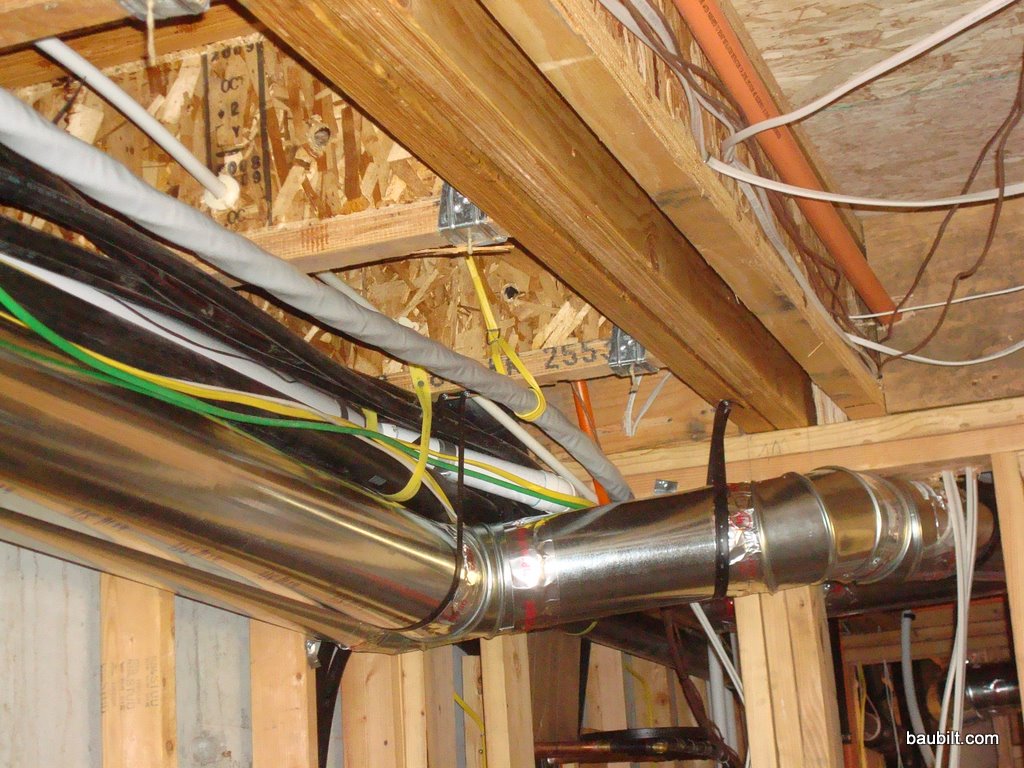
We mostly passed our “four way” inspection on Thursday. The four-way includes structure, electrical, mechanical, and plumbing. We were still waiting on some ducting to be finished, but the inspectors were impressed and gave us the go-ahead to insulate.

The traffic in the joist bays has been just awful the past week; a bunch of trades trying to fit conduits of various kinds into too little space between and across the floor joists. The traffic is especially bad just upstream of the mechanical room.

Here are a few pix.

Continue reading

Dry-In

As soon as the framers got the roof decking on, the roofers came by to do the “dry in.” Normally, this step would comprise laying down “ice shield” (a self-stick membrane) at the eaves of the roof and then “underlayment” (30 lb. asphalt impregnated felt paper or Feltex, a modern polymer equivalent). In our case, we laid down ice shield on the whole roof. It cost about $1000 more in materials, but is another layer of insurance against ice damming. Once the ice shield (or ice shield and underlayment) is put down, the house is dry. It can survive several months of weather with no problems. I’ll be happy to get the real roof on in a week or two, but it’s nice to know that weather is no longer an obstacle to progress on the job.

Pre-Staining Rafter Tails

My framer’s 15-year-old son has been on the site this Summer. I proposed a win-win arrangement in which he pre-stained all the rafter tails and purlins for the roof before his dad and crew put them up. This mostly worked well. (In a few cases, one of the framers had to go up and brush a timber or end of a cut rafter.) I paid him $500, which I consider a screaming deal for both of us. This is the only exterior finish that will have to be done on this house, because we’re using reclaimed barn board siding. I used Cabot semi-transparent oil-based siding stain (Slate Gray). I think it looks excellent and matches the barn board very well. I never plan to restain…I’m hoping that even with stain applied, these rafter tails and purlins will weather gracefully.

Continue reading

Steel Stair

I love the steel stair. The architects designed it conceptually. I worked out a bunch of structural details. The detailer at the steel company created the detailed design. We iterated three or four times to get it right. This stair cost about $3000 for the steel. Waaay less than having some fancy pants stair company do the design and installation. We’re going to use big, chunky treads (3-1/2″ x 11-1/2″), probably out of reclaimed douglas fir (although they were dimensioned such that pieces of a glulam beam turned on their sides would also work).

The railing still needs to be welded in place…but I love it, even in its rough state.

One detail I really like is that we set the steel side stringers on 3/4″ spacers so that we can slip the drywall behind them. The stringers will serve as the baseboard and we’ll get a nice clean interface to the drywall.

Continue reading

My Steel House

When the project is completed, I’ll give a more nuanced reflection on the use of steel in residential construction. At this point, I’m pretty satisfied with the outcome, but the process was pretty painful. The short version of the process is (a) the architects create a beautiful form, (b) the structural engineers are asked to make it work, (c) they have to use lots of steel to realize the vision because of things like seismic requirements and snow loads, (d) a steel company “details” each part from what can only be characterized as a suggestive design by the structural engineers, (e) someone checks it carefully (me, in this case), (f) the steel shows up, (g) the framers integrate it into the structure, and (sometimes) (h) the welder comes out to fix mistakes on site.

We had only a few mistakes, and they were the supplier’s errors, so were fixed at no cost to me. What’s challenging about steel is all the coordination and the inability to adapt much during the process. On the other hand, the stuff is remarkably inexpensive, really strong, and looks nice when exposed (in my opinion).

In the interests of completeness, I should also add that a lot of the steel in this house is architectural in addition to structural. We are using tie rods, beams, and channels as aesthetic features. They’re really nice features, and worth the cost. I have no reservations about our use of steel in this way. My main regret is that we didn’t do a bit more creative problem solving in steps (a) through (c) to find design solutions that did not require as much hidden steel…which is expensive with no visual pay off. (The structural engineers point out that having the house survive a heavy snow fall or an earthquake is a pretty important design requirement. Agreed. But, in some cases with a bit more coordination, the architects could move a window three inches to fit two more 2x6s  in the wall and thus eliminate an expensive, tricky piece of steel.)

Window Installation

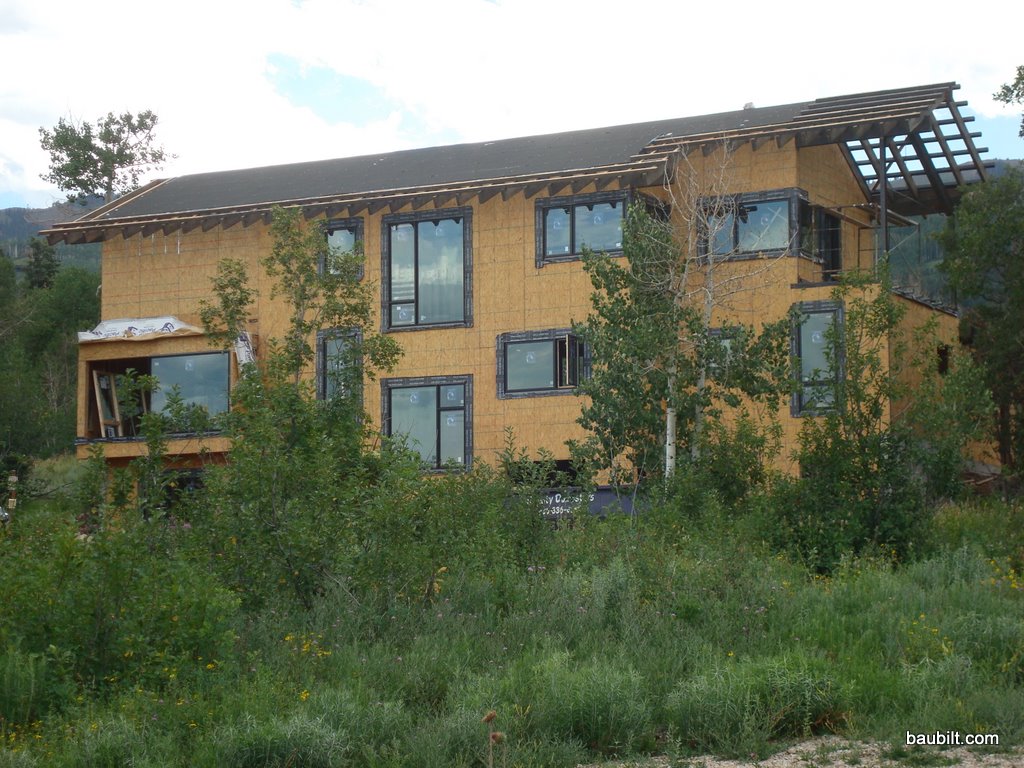
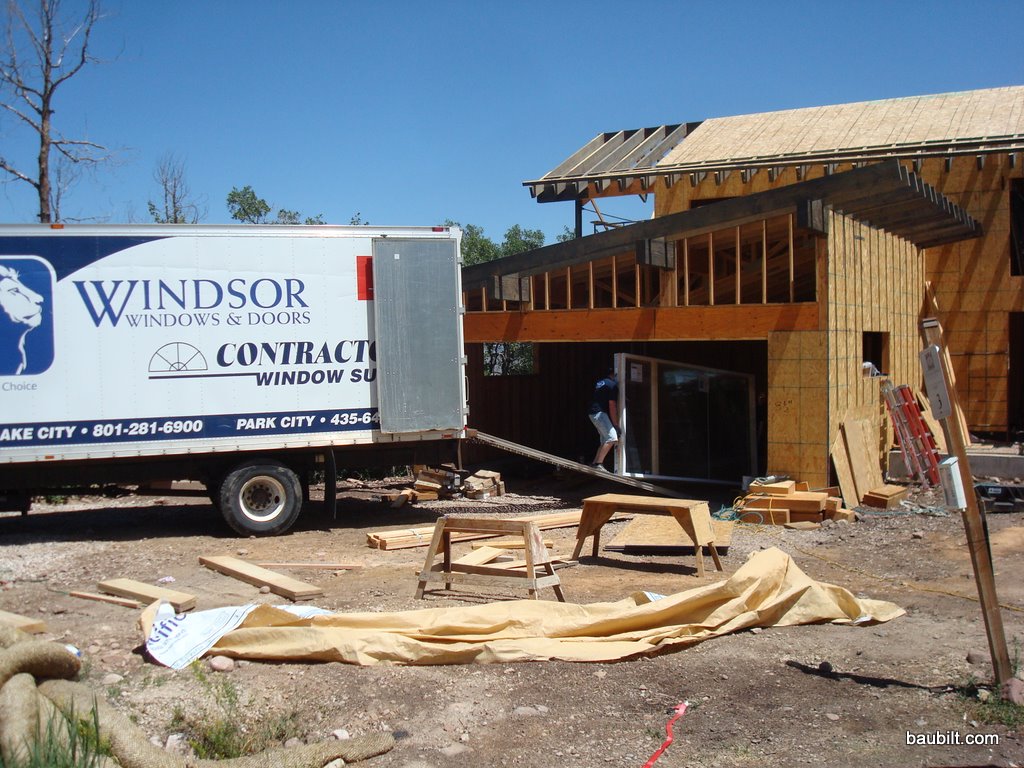
I am using Windsor Pinnacle windows. They are very nice and about 25% less expensive than Pella, which is the other brand I’ve used recently with good results. These are aluminum-clad wood windows, with double Low-E glass. I picked one of the six stock colors (black). The interior is clear pine, which we’ll finish to match the color of the trim as closely as possible.

A shout out to Tim Snyder at Contractors’ Window Supply. He really knows his stuff and made the whole process go very smoothly.

These are big windows…but only one of them has to be field mulled (put together on site). If you can handle the windows during installation, having these big windows mulled at the factory is great.

To calibrate on costs…There are 65 distinct panes of glass on this house. The total cost of these windows was right around $30,000. So, a good rule of thumb for these windows is to budget $450 per pane. Again, these are big…and that includes three patio doors as well. That cost is everything (tax, delivery, hardware, screens).

Continue reading