Monthly Archives: February 2010

Walls are only about 60% insulated.

Many of us have a mental model of insulation as the nice fluffy stuff sandwiched between the inner and outer layers of our walls. The (thermally) ugly reality is that most walls contain lots of doors and windows, and that the wall area that is not doors and windows is full of wood and steel.

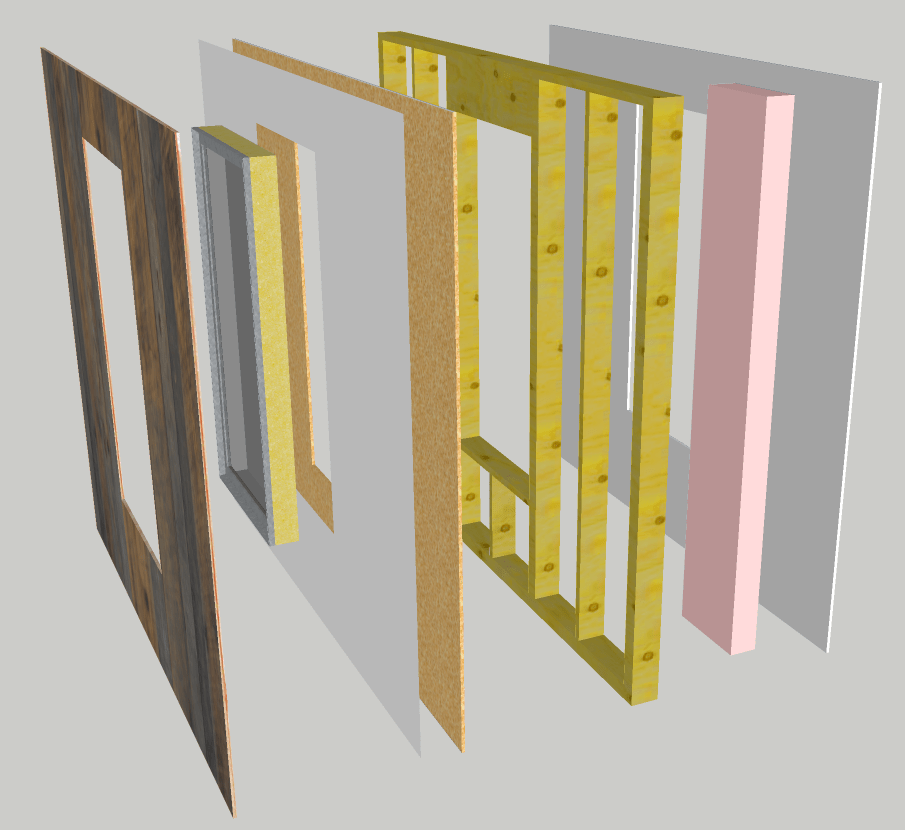
Here is a sketch (thanks to my newly acquired skills in Google Sketchup) of a typical section of wall for my Park City house.

From the outside, the wall is:

Continue reading

Google Sketchup

One of my readers suggested that I try Google Sketchup as a way of doing illustrations. I had used Sketchup when it first became available as a free tool via Google a few years ago. I was intrigued, but never really invested enough time to decide how useful the tool was. I decided it was time to try again.

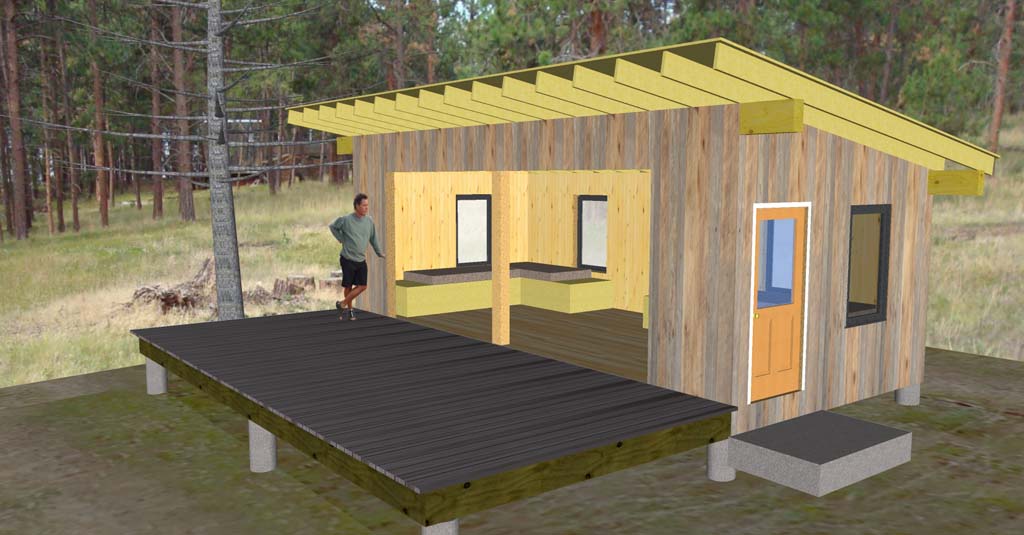
So, yesterday morning, I downloaded version 7.1 and began fresh. I am starting a new project, not yet really documented, to create a “sleeping deck” at my wife’s family’s place in northwest Montana. We have a three-bedroom cabin there, but mostly people like to sleep outside on the deck. The weather is usually perfect in July and August, and remarkably (for someone from New Hampshire) there are essentially no biting insects. The problem is that we are running out of deck space and the few times it rains, there is a mad scramble into the cabin. I’ve been working with the family to design a pavilion, which would include a large deck and a sheltered area. I decided to use Sketchup to model the concept I have been developing.

So, I started at 6am and by 5pm I had some pretty nice images to share with the family. This included learning the tool and building the model. First, here’s the result…

I am pretty skilled in Adobe Illustrator. I know the basics of three-dimensional modeling, but I’ve never really moved beyond the demo phase of real tools like Solidworks. Mostly, I still use pencil and paper. So, I consider myself a decent sketcher, but a complete newbie when it comes to 3D modeling tools.

Continue reading

Ice Dams in Snow Country

On a recent visit to my house site, I saw huge accumulations of icicles and lots of evidence of ice damming. Many neighbors have installed heat tape on their eaves, an affront to elegant design in my opinion. I vowed to design and build a house that skirts the ice damming problem without resorting to active heating of the roof, a colossal waste of energy.

Here is a typical roof in the neighborhood. Icicles more than 10 ft. long hang from the eaves. There is probably significant ice damming at the roof edge. Dangerous, ugly, and a potential source of leaking and water damage.


Ice damming occurs on snow covered roofs when an upper surface of the roof is warm enough to melt snow and when the eave of the roof is cold enough to re-freeze the resulting flow of water. The accumulation of ice at the eave, both visible as icicles and below the snow near the edge, creates a dam that allows water from the melting to build up. If the water backs up far enough, it will flow through seams in the roofing (under shingles, past lapped seams in metal roofs, etc.), and can then flow through the underlayment into living spaces or more typically through the soffit. A telltale sign of ice damming is brown icicles hanging from the underside of the roof, indicating water flowed through the roof and down through the soffit.

Continue reading

Creating Nice Concrete Floors

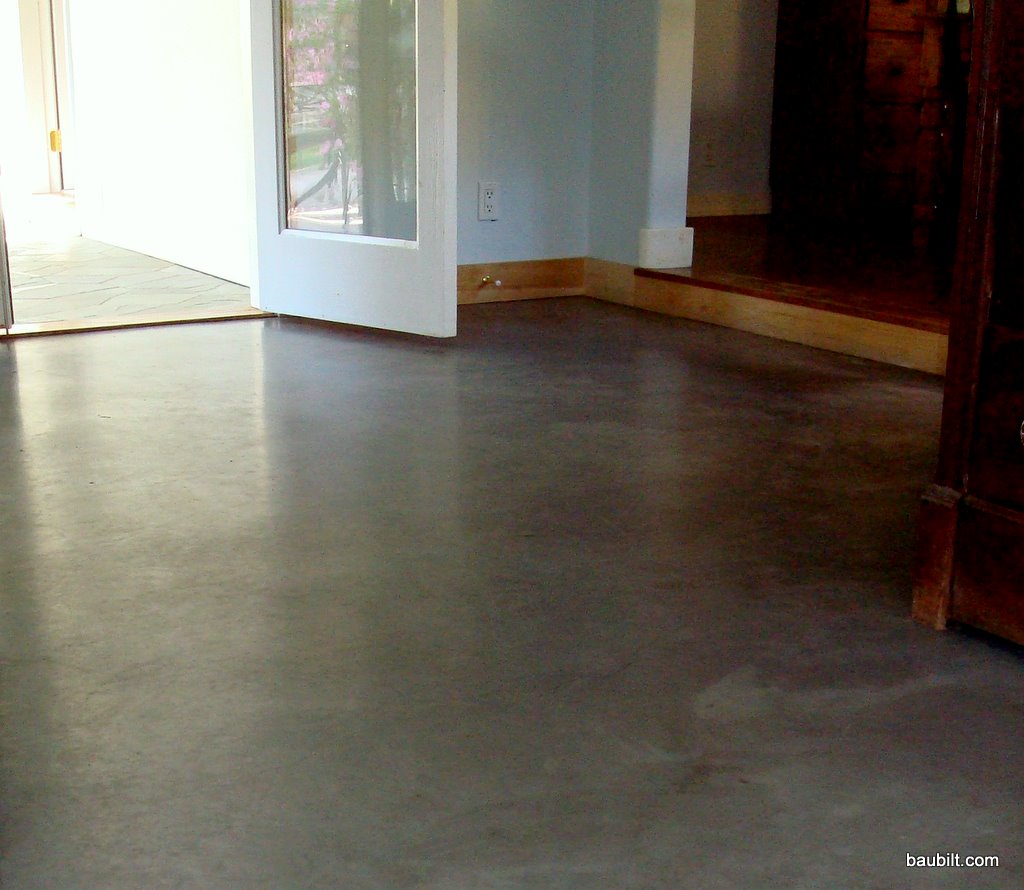
These are my notes on creating nice residential concrete floors. In my primary residence, I put in about 1500 sq-ft of concrete floors in the lower level. I used a 6-inch slab on crushed stone with 1/2 inch PEX tubing for hydronic heating. I’m pretty happy with these floors, although not wild about the results I got in finishing/sealing them. I am in the process of building a second home in which all three levels will have concrete floors. In principle concrete is (a) very inexpensive, (b) a wonderful means of installing hydronic heating, and (c) attractive. But, I’ve found that there is all kinds of confusing information about how to achieve these aims. Here is what I’ve learned based on experience, research, talking to concrete contractors, and my own experiments.

Formulation

Continue reading

Energy Efficient House Design

In this post I explain the analysis I did to understand energy efficiency design issues in my new house.

There are two basic contributors to the energy efficiency of a new house:

1. basic form, and
2. energy efficiency features.

By basic form, I mean what shape does the house have, how many stories is it, and how much window area is there. Those factors matter quite a lot. The most thermally efficient shape (ignoring solar factors) has very little surface area relative to its volume, basically a cube (if you assume the surfaces will be flat not curved). In the analysis I did, I assumed for a base case, a 3200 sq-ft 2-story house, with 8′ ceilings, on a 40′ x 40′ footprint. That’s a pretty boxy shape, but quite efficient thermally.

Windows are wonderful, except that they have just terrible thermal performance, even the really fancy ones. So, you basically have to decide how much glass you want and trade that off against how much energy you are willing to lose. About 12.5% of the wall area on an average new home in the U.S. is windows. I assumed that value in my base case.

OK, that boxy house with average windows in it will lose about 23,000 btu/hr keeping the inside at 70F on a 30F day, a typical heating day in climate zone 6, where I’m building my house. Note that this is not the maximum required heating capacity, which would actually be about 40,000 btu/hr for the -7F design temperature used to size boilers in zone 6. If you assume 200 days a year of 30F weather you get 8000 heating-degree-days, which is pretty close to the actual value for my location.

Continue reading

Optimal Insulation Strategy

My Park City Modern site is at 7000 ft. altitude,  is in climate zone 6, experiences 8196 heating-degree-days, and receives 340 inches of snow per year on average. Dealing with weather is a huge issue in designing for this site.

I will use natural gas as an energy source and wanted to minimize the use of that resource. As a result, I worked to build an energy efficient house that takes advantage of the winter sun. I also skipped the heated driveway, to my neighbors’ dismay.

My insulation plan is as follows:

Roof System

22 gauge cold-rolled corrugated roofing on

roofing felt with ice shield on the lowest 6′ of the roof on

ventilated nail base on

OSB decking on

Double 2×12 rafters 24 inches on center

Wall System

Foundation System

Flash and batt roof

Flash and batt walls

2″ XPS foam on outside of foundation walls

Fiberglass batts on interior of foundation walls
Some Comments

In order of priority, if you want to minimize heat loss, here is what you do:

Minimize windows

Minimize air infiltration

Minimize surface area

Maximize R-value

Minimize bridging through wood and steel structure

Most important insulation

Perimeter of concrete slab

Roof

Maximize winter solar gain

Condensation and Dew Point
McMaster-Carr

Everyone in the engineering world knows McMaster-Carr, but few people in the DIY world do. McMaster is a privately held company based in Illinois that may be the world’s largest engineering superstore. They have hundreds of thousands of items and in twenty plus years of using them I don’t think I’ve ever experienced a stock out. Remarkable.

They have everything. What do I mean by “everything”? Well, you can buy stainless steel spring wire, storage bins, a work bench, a belt sander, fasteners, and (literally) a kitchen sink.

You wouldn’t want to use McMaster for something you can get at Home Depot, even though they have almost everything Home Depot does, but they fit the bill when you need something a little bit out of the ordinary or you want to use an industrial/commercial product in your personal project.

Here are some nice items I’ve used them for in my projects:

  • Copper sheet.
  • John Boos “butcherblock” countertops (under “Maple tops”) at $16/sq-ft
  • Richlite lab bench material (the predecessor to the oh-so-trendy Paperstone…called “phenolic tops” at McMaster) at $26/sq-ft
  • Heavy-duty urethane casters to support a huge rolling shelving unit.
  • Acme threaded rod for shelf supports.
  • Any manner of weird drill bit or fastener.
  • “Speedrail” tubing fittings for railings, etc.

They take credit cards. They ship the same day by UPS.

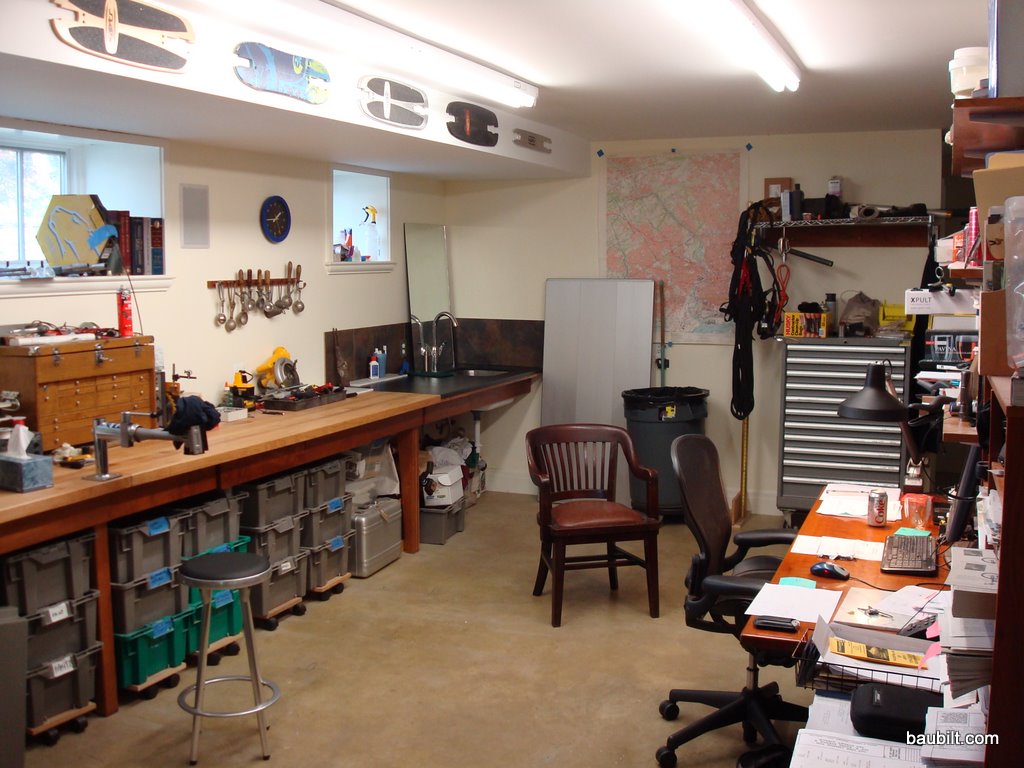
My workbenches shown here (on the left) have McMaster tops (both butcher block and Richlite).

eMachineshop

I described the Ponoko laser cutting service and the Misumi semi-custom parts service. As nice as those are, sometimes you just need to make something out of a chunk of aluminum with a good old fashioned machine tool. Of course you can try to remember how to do that yourself, or find a really handy friend who can do it for you. Most of the time, I use emachineshop.com.

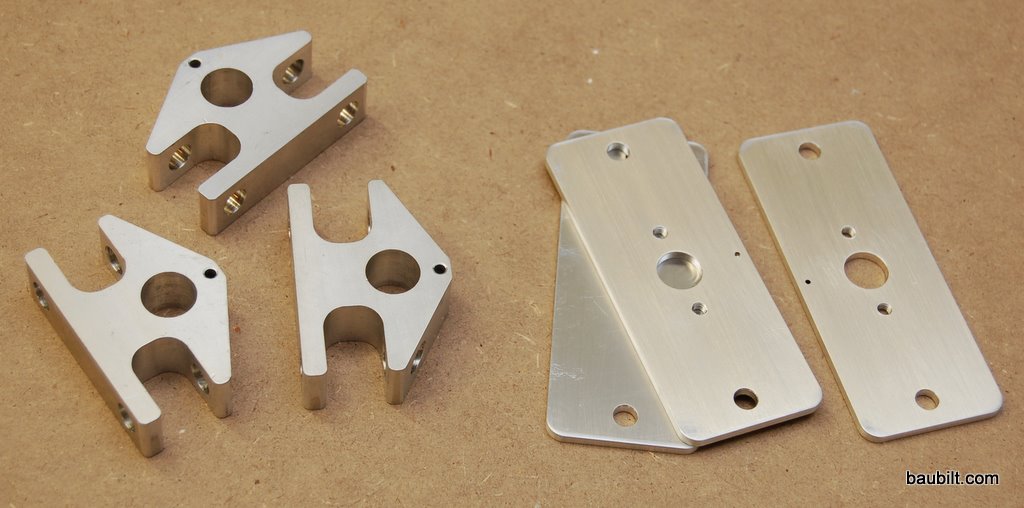
Here are some parts I made using the eMachineshop service.


Here are the eMachineshop parts combined with the Ponoko parts and the Misumi parts to make the completed assembly.

Continue reading

Misumi Made-To-Order Metal Parts

Occasionally my expertise as an engineer carries over into the Baubilt world. Here is one such case. If you need to make fussy little shafts or brackets for some DIY project like a light fixture or a toilet paper holder, consider using the Misumi service. Misumi is a Japanese company that has a huge collection of semi-custom parts (hundreds of categories really) that are made to order using your uniquely specified parameters. For example, let’s say you need a stainless-steel rod 8mm in diameter and 96mm long for some perfect door pull you are designing. You can order that part from Misumi and it will be made to order on a computer-controlled machine tool (in Japan) and shipped directly to you…for remarkably short money.

Here are some parts I had made for use with the Ponoko parts described elsewhere. I think I had 10 sets made, and have already used 7 of the sets by now. My recollection is that these parts were $5-15 each, which is a screaming deal for a custom machined part. The trick of course is that these aren’t really custom; they are semi-custom parts that are made to order with your pre-specified dimensions.

Here is a Misumi page showing a “shaft support”…could be a towel rod support, no?

The Morso 1410 Woodstove

I had experimented with propane space heaters and concluded that I needed somewhere between 10,000 and 30,000 btu/hr of power to keep the Mini Cabin warm in the dead of winter, when temperatures drop below 0 F. (Specifically, I found I could maintain 30F temperature difference between inside and outside at 10,000 BTU/hour. BTW, for the non-US reader, 10,000 btu/hr is about 3 kw.) I also reasoned that I could always open an upper window if things got too toasty. Still, 30,000 BTU/hr is a very small wood stove. So, I went looking for the smallest nice woodstove on the market. I chose the Morso 1410.

Continue reading