Author Archives: Karl T. Ulrich

Unknown's avatar

About Karl T. Ulrich

CIBC Endowed Professor - The Wharton School. I teach, research, and practice innovation, entrepreneurship, and design.

Accelerating Oxidation of Steel Siding Panels

The cold-rolled steel roof has oxidized nicely over the fall and winter. It looks pretty good. Most of the steel siding is starting to turn as well, but it is pretty well protected from water, and with temperatures mostly below 50F, the oxidation rate is slow. Still, I’m pretty sure that by the end of the summer, most of the steel siding will have a decent patina on it.

However, the steel panels on the front of the house are very well protected. They basically never get wet. By mid-Spring they were looking pristine. So, I decided I would accelerate the process. Here is the siding in that area before I did anything…

I mixed 1/4 muriatic acid (standard stuff at Home Depot) with 3/4 tap water in a spray bottle. (Be very careful. Muriatic acid is, well, acid. It really does burn your skin and can destroy your eyes, too. Gloves and safety glasses/goggles are essential.) I simply misted the entire wall surface with the spray bottle. In 24 hours, as long as the temperature is above about 50F, the entire surface will be very rusted. You can see where you have missed spots and just hit those again. I’ll be curious to see how the accelerated oxidation compares in color to that of the naturally oxidized surface. You can already see that where water has bounced onto the wall, the surface is more orange. Anyway, I’m pretty happy with the results. I would be curious to know if an even milder acid would work (e.g., white vinegar). I bet it would, especially if the temperatures were a bit higher.

Continue reading
Replacing a Pressure Relief or T&P Valve

This is not an interesting topic. However, I couldn’t find what I needed for this little project on Google, so figured I’d create a post that is likely to be found when people are searching for a solution to a leaking relief valve.

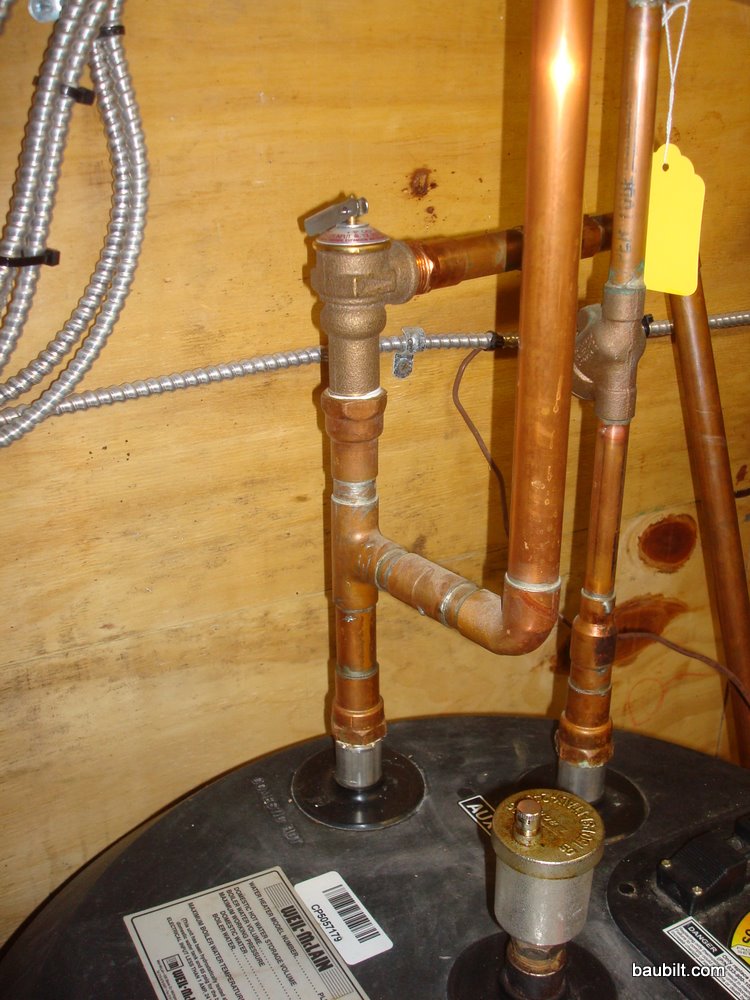
Your water heater has a T&P valve, which stands for Temperature and Pressure Valve. This valve opens when temperature and/or pressure exceed a pre-defined threshold. This is a safety feature so that your water heater does not explode if the pressure goes too high. I have a Weil Mclain Superstor indirect water heater and the T&P Valve is on the top, as shown below. It usually is designed to open at 210F and/or 150 psi, which is waaay above the safe operating temperature and pressure of a domestic water heater. Watts is the leading brand of these devices.

Your boiler (for your forced water heating system) also has a relief valve. However, this one is just a pressure-relief valve. It usually opens at 30 psi, which is well above the system pressure of most forced-water heating systems. So, while your water heater has a T&P valve, your boiler has a P valve. The valve on my Weil Mclain Ultra is shown below.  The valves in my system all are bronze with 3/4″ threads.

Continue reading

Excellent Hanging Shelf Hardware

My architects like hanging shelves and I do too. They often take the “cowboy” approach of using galvanized threaded rod and nuts and washers to support the shelving. I wanted something a little more refined, but didn’t want to pay hundreds of dollars for fussy little European hardware bits. Here’s a solution I came up with, which has proven to be excellent in all respects.

Here’s a detail of the hardware:

Continue reading

Construction Costs – Park City Modern House

I finally had a few minutes to sort my actual construction expenses and put them in some reasonable categories. This is a brief summary of the construction costs.

First, the basic parameters of the house:

  • 4348 sq-ft of space, including the garage
  • 3-level “walk-out” design
  • 2092 sq-ft footprint
  • 4 bedrooms
  • Cathedral ceilings in upper levels
  • 5 bathrooms
  • Enclosed deck on upper level
  • Front and rear paver terraces

The total construction costs were $619,000. This is every dime I spent from the time we applied for a permit to the time we received the certificate of occupancy. It does not include the design fees (architect + structural engineer), which were about $60,000. It also does not include the cost of about 15 trips from Philadelphia to Utah, which cost about $10,000.

The cost comes out to $142/sq-ft of enclosed space. The square footage includes the garage but does not include the enclosed deck off the master bedroom, nor the covered terrace. I believe the calculation should include the garage, because the garage basically has the identical finishes as the rest of the house (same concrete, framing, drywall, paint, windows, casing, electrical, etc.).

In many ways calculating by the square foot is misleading. So, I’m providing a lot of detail on the costs by category in the following PDF file. This breaks down the costs by item with the usual “units” that are used to calculate the costs. For instance, the counter tops cost $7489 and comprised 135 sq-ft for a cost of $55/sq-ft.

Continue reading

Lower Stair

The building materials supplier had promised hemlock stair parts would be delivered two days before our target completion date. Eric, the finish carpenter, was ready to install the stair in a day. Then, they flaked out on us, saying it would be two more weeks. We needed Plan B.

We found that MacBeath Hardwood had clear, vertical-grain douglas fir in stock in rough 4/4 thickness. So, we bought a couple of hundred board feet of the material and planned to set up our own mill to make the flooring, treads, and risers.  MacBeath delivered the material to the job site in FOUR HOURS. The wood was beautiful and mostly in 14-16′ lengths. Had I known how nice this material was, I would have used it for door/window casing too. (However, it was expensive…about $6/bf for the rough material.)

Continue reading

Wall Art?

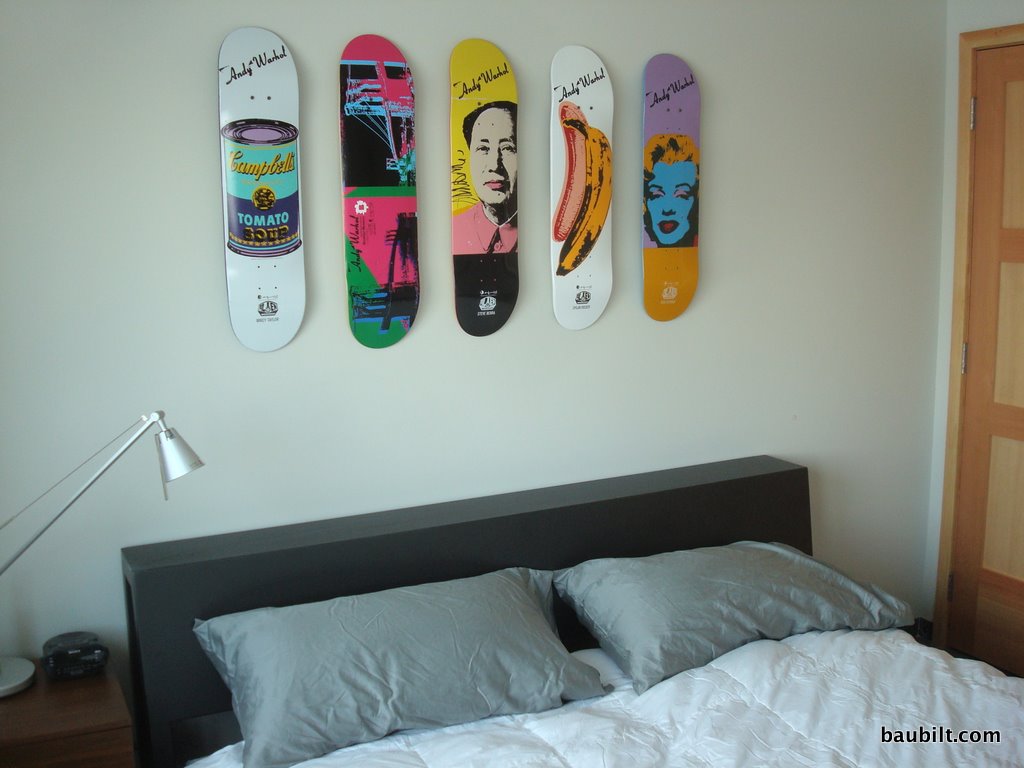
Making blank walls visually interesting is a challenge. Here’s one idea that worked out very well. I was inspired by the arrival in the mail of my son’s thick catalog of skateboard decks. We found a cool collection of Warhol images on decks and bought five of them for a total of less than $200. Here they are on his wall.

Continue reading

Roof Performance

I’ve now observed a few weeks of snow on the roof. So far no ice dams and very few icicles…just what has resulted from the sun melting snow at the fringes of the exposed roof.

The snow slid off one section of the roof (the northeast corner, strangely). It was pretty dramatic when it went. We had a few quite warm days last week (around 35F/2C) and I think the ventilated roof actually allowed melting at the roof surface when warm air vented up through it. The snow bars above the hot tub are working very well.

Continue reading

Moving In

A surprising amount of work lies between getting a certificate of occupancy (i.e., technically finishing the house) and moving in. In my case, the C.O. was issued on Tuesday and my family was scheduled to arrive on Thursday. I had ordered a house full of stuff which was piled in boxes everywhere as we were finishing the house. But, first, the layers of dust had to be removed. A hardworking crew of husband, wife, and 17-year-old son came in at 5pm on Tuesday and worked until 1am on Wednesday to clean the house. They vacuumed up a lot of dust, wiped down all surfaces, did a quick wash of interior window surfaces, mopped floors, and cleaned bathrooms. Wednesday and Thursday I sealed floors and unpacked boxes.

Continue reading